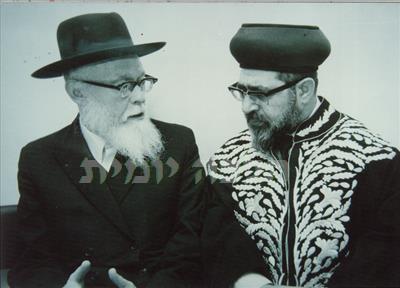
מרן זצ"ל עם הגרי"ש אלישיב זצ"ל
The following laws apply to any Torah scholar; even if one has not studied any Torah from this individual, one must nevertheless afford him honor in several ways, as we shall explain.
The Rambam (Chapter 6 of Hilchot Talmud Torah) states: “It is a grave sin to degrade Torah scholars or to hate them. Jerusalem was only destroyed once people humiliated Torah scholars, as the verse states (Divrei Ha’Yamim 36), ‘And they mocked the messengers of G-d and despised his words and scoffed at his prophets until the wrath of Hashem rose up against his people till there was no remedy.’” This means that the people would mock those who studied the word of Hashem, i.e. Torah scholars, and this caused Hashem great anger until He eventually allowed for Jerusalem to be destroyed.
The Mishnah (Sanhedrin 90a) states: “The following individuals do not have a share in the World to Come: One who says that the Resurrection of the Dead is not derived from the Torah, that the Torah is not from Heaven, and an apostate.” The Gemara (ibid. 99b) states that both Rav and Rabbi Chanina explained that “an apostate” refers to one who degrades Torah scholars. Thus, one who humiliates Torah scholars has no share in the World to Come.
If one humiliates a Torah scholar and then two witness come before a Bet Din and testify that this was the case, Bet Din publicly excommunicates the individual and he charged with a heavy fine. According to the letter of the law, if a Torah scholar is degraded by an individual, the Torah scholar himself may place an excommunication on the guilty party and the excommunication takes effect at which point the entire nation who may not be Torah scholars like the one who placed the excommunication to treat the excommunicated party with the appropriate laws, such as not counting him as part of a Minyan and not sitting within a four Amot radius, until the Torah scholar forgives the individual and releases the excommunication.
The Rambam writes that although a Torah scholar may excommunicate someone who has insulted his honor, it is not praiseworthy for him to do so; rather, the Torah scholar should ignore the words of the ignoramus who insulted him and this was actually the way of pious individuals that when they would hear themselves being mocked, not only would they not respond, they would actually forgive the guilty party as well. Nevertheless, this only applies when the Torah scholar was degraded privately. However, if a Torah scholar is humiliated by another in public, the Torah scholar may not absolve his honor and if he does so he shall be punished, for this is an affront to the Torah. Rather, he must rise up against this person like a snake until the individual requests forgiveness.
Approximately forty years ago, a certain individual humiliated Maran Rabbeinu Ovadia Yosef zt”l in Yeshivat Porat Yosef in front of a large crowd of people. Maran zt”l proceeded to excommunicate the individual. This person then went to the Chief Rabbi of Jerusalem, Hagaon Harav Betzalel Zolty zt”l and to Hagaon Harav Yosef Shalom Elyashiv zt”l in order to complain to them about this matter. When they heard about the excommunication, they immediately began treating the man in the manner appropriate to such individuals. Eventually, this person came before Maran zt”l accompanied by Hagaon Harav Yehuda Tzadka zt”l, Rosh Yeshivat Porat Yosef, and he asked for Maran’s forgiveness. Certainly, an excommunication placed by the leader of the generation is so much worse than one placed by any other Torah scholar, for one who humiliates the leader of the generation is tantamount to humiliating one’s primary rabbi (as we have explained in previous Halachot that they share the same law).
Another incident occurred approximately ten years ago when an individual degraded Maran zt”l publicly. Maran then arrived at the Bet Midrash Yechave Da’at and placed an excommunication on this man. All of Maran’s students immediately began observing the laws excommunication towards this individual. Eventually, this individual regretted his actions and came to Maran and begged for forgiveness; Maran zt”l then forgave him and wrote him a note that the individual had apologized and that he had forgiven him and released the excommunication.
On the other hand, there were numerous times when people insulted Maran’s honor in various newspapers and periodicals and we, his students, wished to make a protest for the honor of his Torah, however, Maran zt”l requested that we take no action and he would characteristically forgo his honor and forgive these individuals. Even when these individuals who insulted him came before him on certain occasions, such as when he was sitting Shiva for his son and these individuals came before him to comfort him, Maran zt”l still treated them with utmost respect and love in his classic way of bringing people closer in order to aid in reaching our common goal of raising the banner of Torah and Mitzvot.
